
The Witcher series has captivated audiences worldwide with its rich characters and complex storylines. One character that has sparked intense debate among fans is Ciri, the adopted daughter of Geralt of Rivia. Her relationships and sexuality have been a topic of discussion, particularly with the release of the Netflix series.
Ciri’s character development in The Witcher books is multifaceted, with her destiny intertwined with that of Geralt’s. As fans delve into the series, questions about her romantic inclinations have emerged, including speculation about her being lesbian or bisexual.
This article aims to explore Ciri’s character and her relationships as depicted in The Witcher books, providing insight into her sexuality and its significance in the narrative.
Table of Contents
Who is Ciri in The Witcher Universe?
In the vast universe of The Witcher, Ciri stands out as a character of immense power and royal heritage. She is a central character in Andrzej Sapkowski’s series, known for her unique abilities and complex background.
Ciri’s Background and Royal Lineage
Ciri’s identity is deeply rooted in her royal lineage and supernatural heritage. She is known as the Lion Cub of Cintra and possesses the Elder Blood, making her a significant figure in the world of The Witcher.
Princess of Cintra
As the princess of Cintra, Ciri is the daughter of Pavetta, making her a member of the royal family. This lineage is crucial to understanding her role in the political landscape of The Witcher world.
Child of Elder Blood
Ciri is also known as the Child of Elder Blood, indicating her possession of supernatural abilities and a special destiny. This aspect of her identity sets her apart and makes her a target for various factions within the series.
Her Journeys Throughout the Saga
Ciri’s journey is a pivotal aspect of The Witcher saga. She undergoes significant training and faces numerous challenges, shaping her into a powerful character.
Training at Kaer Morhen
At Kaer Morhen, Ciri receives training from the Witchers, learning combat skills and about her heritage. This period is crucial for her development as a character and her understanding of her abilities.
Life as “The Swallow”
Ciri adopts the alias “The Swallow” during her travels, symbolizing her freedom and her role as a fugitive. This identity is a key part of her journey, as she navigates the complexities of her destiny.
Understanding Sexuality in The Witcher Books
The Witcher book series by AndrzejSapkowski is known for its complex characters and nuanced exploration of human sexuality. This aspect of the series has garnered significant attention from both fans and literary critics.
AndrzejSapkowski’s Progressive Approach to Sexuality
Sapkowski’s handling of sexuality in The Witcher is often described as progressive. He weaves complex sexual identities into the narrative, making the series a subject of interest for discussions on LGBTQ+ representation.
LGBTQ+ Representation in the Series
The series includes characters with diverse sexual orientations, contributing to a richer portrayal of the Witcher world. LGBTQ+ characters are integrated into the story without being the focal point, adding depth to the narrative.
Author’s Statements on Character Sexuality
In interviews, Sapkowski has discussed his intentional inclusion of diverse sexual identities, highlighting his belief in representing the complexity of human experience.
Cultural Context Within the Witcher World
The Witcher series is set in a medieval-inspired world with its own cultural norms and attitudes toward sexuality.
Attitudes Toward Same-Sex-Relationships
The books depict a world where same-sex relationships exist, sometimes facing societal scrutiny, mirroring real-world historical contexts.
Gender Roles in the Northern Kingdoms
Gender roles are also explored, with female characters often holding significant power and influence, challenging traditional medieval gender stereotypes.
| Aspect | Description |
|---|---|
| LGBTQ+ Representation | Inclusion of diverse sexual orientations |
| Cultural Context | Medieval-inspired setting with nuanced attitudes toward sexuality |
| Gender Roles | Complex portrayal with powerful female characters |
Is Ciri a Lesbian in the Books? TextualEvidence
The Witcher series by Andrzej Sapkowski presents a complex exploration of Ciri’s character, including her relationships and sexual identity. To understand whether Ciri can be considered a lesbian in the books, it’s essential to examine the textual evidence provided in “Time of Contempt” and “The Tower of the Swallow.”
Key Passages from “Time of Contempt”
“Time of Contempt” is a pivotal book in The Witcher series, offering significant insights into Ciri’s interactions and relationships. Two key aspects to consider are her encounters with the Rats and the intimate scenes described in the narrative.
The Rats and Initial Encounters
Ciri’s association with the Rats, a group of young women with a troubled past, marks a significant point in her journey. These interactions are not merely platonic; they involve a level of intimacy and bonding that is crucial to understanding Ciri’s perspective on relationships. The Rats’ leader, Giselher, and Ciri develop a close bond, which can be interpreted as having romantic undertones.
Intimate Scenes and Their Context
The narrative includes descriptions of intimate scenes between Ciri and the Rats, which are significant in understanding Ciri’s sexual identity. These scenes are not gratuitous but serve to illustrate Ciri’s exploration of her sexuality and her need for connection and acceptance. The context of these scenes suggests that Ciri is drawn to women, indicating a potential lesbian orientation.
Evidence from “The Tower of the Swallow”
“The Tower of the Swallow” continues the exploration of Ciri’s character, delving deeper into her reflections on her relationships and her understanding of her own identity.
Ciri’s Reflections on Her Relationships
In “The Tower of the Swallow,” Ciri reflects on her experiences with the Rats and other characters, providing insight into her perceptions of these relationships. Her reflections suggest a deep emotional connection with the women she has encountered, further supporting the interpretation of a lesbian identity.
Dialogue Revealing Sexual Preferences
The dialogue in “The Tower of the Swallow” includes moments where Ciri’s sexual preferences are implicitly revealed. These moments are crucial in understanding her sexual identity and are often subject to interpretation by readers. The text suggests that Ciri is inclined towards women, reinforcing the notion of a lesbian orientation.
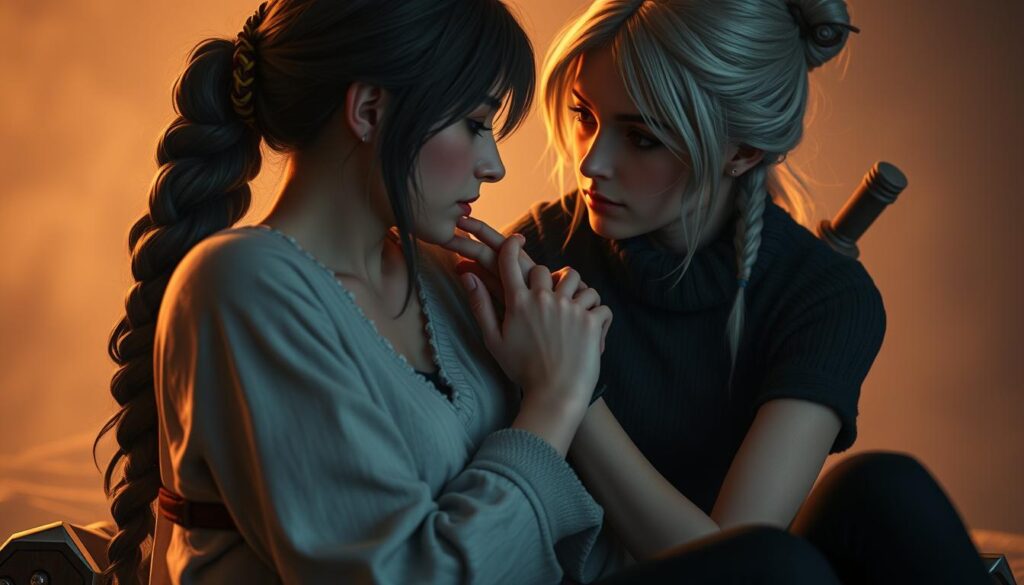
Ciri’s Relationship with Mistle: A Deep Analysis
Ciri and Mistle’s connection is a significant element in the narrative, exploring themes of trauma and intimacy. Their relationship is multifaceted, influenced by the harsh realities of their world.
The Beginning: Trauma and Protection
Their bond began under circumstances marked by trauma and the need for protection. Ciri, having faced numerous challenges, found solace in Mistle’s company.
The Controversial First Night
The first night they spent together is a pivotal moment, sparking controversy among readers. This event can be seen as a turning point in their relationship, raising questions about consent and power dynamics.
Development of Genuine Feelings
As their relationship progressed, Ciri and Mistle developed genuine feelings for each other. Their bond deepened, becoming a source of strength for both characters.
The Complexity of Their Bond
Their relationship is characterized by a complex interplay of emotions and power dynamics. Understanding this complexity is crucial to appreciating the depth of their connection.
Power Dynamics Between Them
The power dynamics between Ciri and Mistle are nuanced, influenced by their experiences and the circumstances of their world. This dynamic adds layers to their relationship.
Ciri’s Grief After Mistle’s Death
Ciri’s reaction to Mistle’s death underscores the depth of their bond. Her grief is a testament to the significance of Mistle in her life, highlighting the emotional stakes of their relationship.
OtherRomantic and Sexual Encounters in the Books
The Witcher series by Andrzej Sapkowski presents Ciri’s diverse interactions with both male and female characters, influencing her understanding of romance and sexuality. These encounters are pivotal in shaping her identity and experiences throughout the saga.
Ciri’s Interactions with Male Characters
Ciri’s relationships with male characters are multifaceted, reflecting various aspects of her personality and the challenges she faces.
The Relationship with Galahad
Ciri’s encounter with Galahad is significant, as it represents a connection with someone who understands her without judgment. This relationship highlights Ciri’s capacity for deep emotional bonds. Galahad’s character serves as a contrast to other male figures in Ciri’s life, showcasing a different aspect of her emotional spectrum.
Other Potential Male Interests
Besides Galahad, Ciri interacts with other male characters, some of which may hint at potential romantic interests or emotional connections. These interactions are crucial in understanding Ciri’s broader emotional landscape. They add complexity to her character and demonstrate her ability to form various types of relationships.
Female Relationships Beyond Mistle
Ciri’s connections with female characters are equally complex, ranging from friendships to potential romantic relationships.
Friendships vs. Romantic Connections
Distinguishing between friendships and romantic connections in Ciri’s relationships with women can be challenging. The context and subtext of these interactions are vital in understanding their nature. Sapkowski masterfully crafts these relationships, leaving room for interpretation.
Subtextual Elements in Female Relationships
The Witcher books often embed subtextual elements in Ciri’s female relationships, suggesting deeper emotional or romantic undertones. Analyzing these elements provides insight into Ciri’s sexual identity. These subtextual cues are essential in understanding the nuances of Ciri’s interactions and their impact on her character development.
Bisexuality vs. Lesbianism: Analyzing Ciri’s Sexual Identity
Ciri’s journey in The Witcher series is marked by complex relationships that challenge straightforward categorization of her sexual identity. As the narrative unfolds, Ciri’s interactions with various characters provide insight into her sexual orientation, sparking debate among readers about whether she identifies as bisexual or lesbian.

Evidence Supporting Bisexual Interpretation
Several aspects of Ciri’s character suggest a bisexual interpretation. Her attraction to multiple genders and the fluidity in her desires are key factors in this analysis.
Attraction to Multiple Genders
Ciri’s relationships with both male and female characters are significant. For instance, her bond with Mistle, a female character, is deep and intimate, while her interactions with male characters also indicate a level of attraction.
Fluidity in Her Desires
The fluidity in Ciri’s desires is evident in how she navigates different relationships throughout the series. This fluidity supports the argument that her sexual identity is not fixed to one gender.
| Character | Gender | Nature of Relationship |
|---|---|---|
| Mistle | Female | Intimate, Romantic |
| Geral of Rivia | Male | Protective, Familial |
| Yennefer | Female | Maternal, Affectionate |
Arguments for a Lesbian Reading
Conversely, there are arguments supporting a lesbian interpretation of Ciri’s sexual identity, focusing on the quality of her same-sex attractions and the narrative’s handling of compulsory heterosexuality.
Quality of Same-Sex vs. Opposite-Sex Attractions
The depth and intimacy of Ciri’s relationship with Mistle are often cited as evidence of a lesbian identity. This relationship is portrayed as particularly significant in the narrative.
Compulsory Heterosexuality in the Narrative
The series sometimes pressures Ciri into situations that could be seen as compulsory heterosexuality, yet her true desires seem to align more with her same-sex attractions.
In conclusion, Ciri’s sexual identity remains a topic of debate, with valid arguments on both sides. The complexity of her character and the nuanced portrayal of her relationships in The Witcher series support multiple interpretations.
Coming of Age: Sexuality as Part of Ciri’s Character Development
As Ciri navigates the complexities of her identity, her experiences with sexuality play a crucial role in her character development. This aspect of her journey is marked by significant challenges and revelations that shape her understanding of herself.
Trauma and Its Impact on Sexual Identity
Ciri’s experiences with trauma have a profound impact on her sexual identity. The trauma she faces influences her perceptions of intimacy and relationships.
Sexual Violence in Ciri’s Story
Ciri’s encounters with sexual violence are a pivotal aspect of her narrative, affecting her sense of self and her understanding of her sexuality. The trauma she experiences shapes her initial perceptions of intimacy.
Finding Safety in Same-Sex Relationships
In the midst of turmoil, Ciri finds solace in same-sex relationships, which provide her with a sense of safety and understanding. This is particularly evident in her bond with Mistle.
Agency and Self-Discovery Throughout the Saga
As Ciri navigates the Witcher world, she gradually asserts her agency and embarks on a journey of self-discovery. This journey is crucial in helping her understand her desires and identity.
Breaking Free from Others’ Expectations
Ciri’s path to self-discovery involves breaking free from the expectations imposed upon her by others. She begins to forge her own identity, independent of external influences.
Ciri’s Own Voice on Her Desires
Through her experiences, Ciri eventually finds her own voice to express her desires and identity. This newfound agency is a significant milestone in her character development.
| Aspect | Impact on Ciri |
|---|---|
| Trauma | Shapes her perceptions of intimacy and relationships |
| Same-Sex Relationships | Provides a sense of safety and understanding |
| Agency and Self-Discovery | Enables her to forge her own identity and express her desires |
“Ciri’s journey is a complex exploration of identity, trauma, and self-discovery.”
Fan Interpretations and Scholarly Analysis
Fan interpretations and scholarly analysis of Ciri’s character have unveiled a complex web of discussions around her sexuality. The Witcher community has been actively engaged in debating and analyzing Ciri’s interactions and relationships throughout the series.
The Witcher Community Discussions
The community discussions around Ciri’s sexuality have been vibrant and multifaceted. Fans have shared their insights and interpretations across various platforms.
Common Readings of Ciri’s Sexuality
Many fans have interpreted Ciri’s relationships, particularly with Mistle, as indicative of a lesbian or bisexual identity. These readings are often based on the emotional depth and significance of these relationships within the narrative.
Debates and Disagreements
However, not all fans agree on Ciri’s sexual identity, leading to lively debates. Some argue that her interactions with male characters also play a significant role in understanding her sexuality.
Literary Analysis of Ciri’s Character
Scholars have also weighed in on Ciri’s character, applying various literary theories to understand her role and identity within the Witcher saga.
Queer Theory Perspectives
From a queer theory perspective, Ciri’s character can be seen as challenging traditional norms of sexuality and identity. This perspective highlights the fluidity of Ciri’s relationships and her resistance to categorization.
Feminist Interpretations
Feminist interpretations focus on Ciri’s agency and autonomy, particularly in her relationships. These analyses often discuss how Ciri navigates a patriarchal world, asserting her identity and desires.
The intersection of fan interpretations and scholarly analysis provides a rich understanding of Ciri’s character. By examining both, we gain insight into the complexity of her sexual identity and its significance within the narrative.
Conclusion: The Complexity of Ciri’s Sexual Identity
Ciri’s sexual identity is a complex and multifaceted aspect of her character, open to various interpretations. Throughout The Witcher book series, Andrzej Sapkowski masterfully crafts Ciri’s journey, weaving together elements that contribute to the richness of her character.
The relationship between Ciri and Mistle, as well as her interactions with other characters, adds depth to the narrative, inviting readers to ponder the complexity of Ciri’s sexual identity. This complexity is a testament to Sapkowski’s progressive approach to character development.
As the series concludes, Ciri’s character remains a subject of intrigue, with her sexual identity being just one facet of her multifaceted personality. The various interpretations of her character underscore the impact of The Witcher series on its fans and the literary world.
In conclusion, Ciri’s character, with her complex sexual identity, continues to captivate audiences, ensuring The Witcher series remains a significant and thought-provoking work in the fantasy genre.